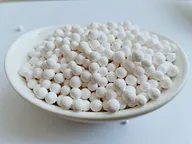


Ceramic Carrier Tjel-008
Tjel-008
Status: Solid Catalyst
Response Type: Hydrogenation
Classification: Homogeneous Catalysts
Usage:Positive Catalyst
HS Code:69091100
Response Type: Hydrogenation
Classification: Homogeneous Catalysts
Usage:Positive Catalyst
HS Code:69091100
Quantity:
Basic Info.
Model NO. | TJEL-008 |
Usage | Positive Catalyst |
Effect Size | Promoter Catalysts |
Manufacturing Method | Method of Precipitation |
Application Industry | Industry |
Shape | Solid |
Color | White |
Transport Package | 160kg Net by Iron Drum |
Specification | 99% |
Trademark | No brand |
Origin | China |
HS Code | 69091100 |
Production Capacity | 5000mts Per Year |
Product Description
Professional supply Ceramic carrier TJEL-008 with good quality
inert aluminum oxide ceramic balls are widely used in many fields, including petroleum, chemical engineering, fertilizer production, and environmental protection. They are used as covering and supporting materials of catalysts in reaction vessels and as packing in towers.
They have stable chemical features and a low rate of water absorption, resist high temperatures and high pressure, and also resist the corrosion of acid, alkali and some other organic solvents. They can stand the change in temperature during the manufacturing process.
The main role of inert ceramic balls is to increase the distribution spots of gas or liquid, and to support and protect the activating catalyst with low strength.
Inert alumina ceramic balls are widely used in petroleum, chemical, fertilizer, and environmental protection industries, as a support material for the catalyst in the reactor and tower packing. Inert alumina ceramic ball has the characteristics of high temperature and high pressure resistance, low water absorption and stable chemical properties. It can withstand the corrosion of acids, bases and other organic solvents and can withstand the temperature changes that occur during production. The main function of the inert alumina ceramic ball is to increase the gas or liquid distribution point, support and protect the active catalyst with low strength.
inert aluminum oxide ceramic balls are widely used in many fields, including petroleum, chemical engineering, fertilizer production, and environmental protection. They are used as covering and supporting materials of catalysts in reaction vessels and as packing in towers.
They have stable chemical features and a low rate of water absorption, resist high temperatures and high pressure, and also resist the corrosion of acid, alkali and some other organic solvents. They can stand the change in temperature during the manufacturing process.
The main role of inert ceramic balls is to increase the distribution spots of gas or liquid, and to support and protect the activating catalyst with low strength.
Inert alumina ceramic balls are widely used in petroleum, chemical, fertilizer, and environmental protection industries, as a support material for the catalyst in the reactor and tower packing. Inert alumina ceramic ball has the characteristics of high temperature and high pressure resistance, low water absorption and stable chemical properties. It can withstand the corrosion of acids, bases and other organic solvents and can withstand the temperature changes that occur during production. The main function of the inert alumina ceramic ball is to increase the gas or liquid distribution point, support and protect the active catalyst with low strength.
No. | Item | Unit | Requirements | Test Results | Test Methods |
1 | Outer diameter | mm | 16.5±1.0 | Vernier caliper, test 10 grains and get the average | |
2 | Inner diameter | mm | 3.1±0.3 | Vernier caliper, test 10 grains and get the average | |
3 | Height | mm | 14.0±1.0 | Vernier caliper, test 10 grains and get the average | |
4 | Bulk density | Kg/m3 | 800-900 | Tested with 6L graduated cylinder | |
5 | Mechanical strength | N/Gr | ≥400 | Vernier caliper, test 40 grains and get the average | |
6 | Water absorption | m% | ≥22.0 | 100ºC×30minutes | |
7 | Al2O3 | m% | ≥99.0 | ||
8 | SiO2 | m% | ≤0.15 | ||
9 | Fe2O3 | m% | ≤0.03 | ||
10 | Na2O+K2O | m% | ≤0.30 | ||
11 | CaO | m% | ≤0.20 |